
Implementing MTSS? Do Not Forget Tier 2 Intervention (Part One)
Why Tier 2
A student approaches the school nurse with both hands wrapped around their head, wincing in pain.
“My head hurts! I need brain surgery!”
The school nurse has seen this before and knows that brain surgery is not the appropriate solution when compared to the over-the-counter pain relievers found in the medicine cabinet.
If an ambulance were called and neurosurgery requested, it would be a completely disproportionate response to a very common problem—not to mention wasteful (and dramatic).
Offering a pain reliever and some rest is a faster, lower-cost, targeted solution with strong evidence of effectiveness.[1]
Schools face similar decisions every day.
MTSS: Matching Support to Student Need
Multi-Tiered Systems of Support (MTSS) is the framework schools use to match the right level of support to the right level of student need, ensuring timely, evidence-based help without over- or under-responding. In practice, it follows the same principles used in public health systems. [2]
In practice, most resources are allocated to Tier 1. We further ensure those resources are evidence-based, implemented with strong fidelity, and outcomes are monitored through quality assessment.
In an ideal model, that should keep 80% of our kids on-track for meeting end of year grade level learning outcomes. [3]
Tier 2 is allocating additional resources to those 10%-15% of kids that need more instruction in addition to tier 1 that is skill-specific and delivers more help, time, opportunities to learn, practice, and/or motivation. [4]
Last, tier 3 is the most intensive educational support for 5% of learners. This may or may not be inclusive of Special Education services.
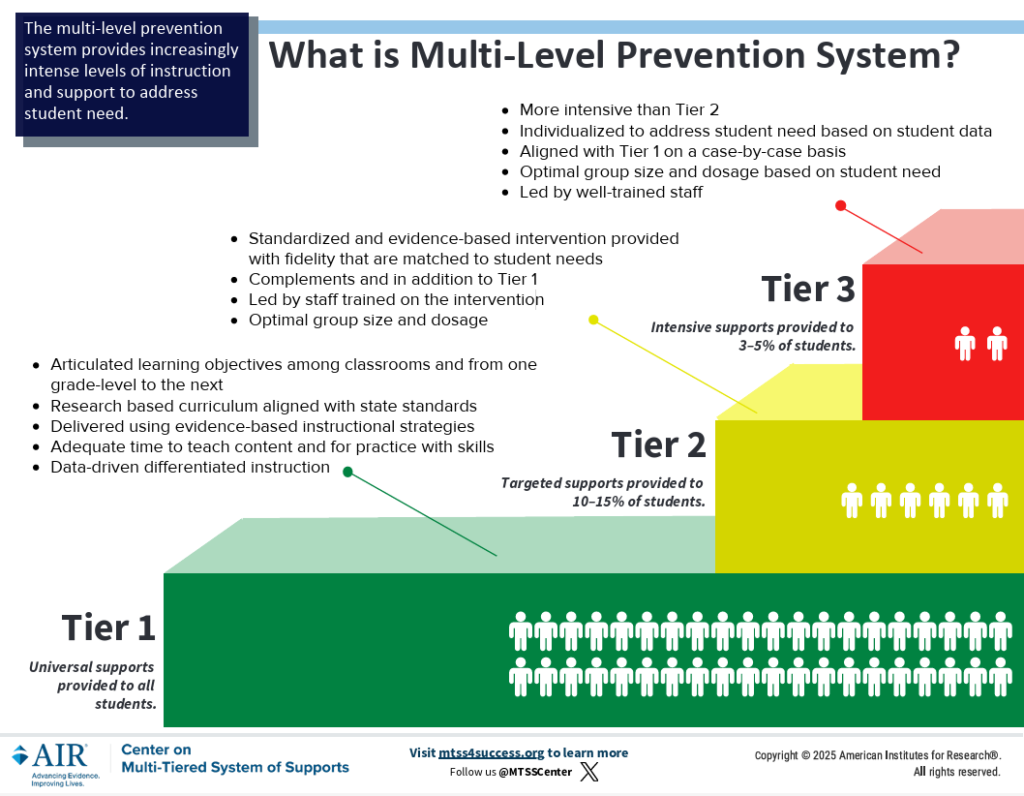
https://www.centralriversaea.org/wp-content/uploads/2024/03/MTSS-Pyramid.jpg
Why Tier 2 Is Often the Right First Response
Research shows that when students experience a “headache” with learning, or early signs that Tier 1 instruction is not fully meeting their needs, providing additional targeted support through Tier 2 is an effective first response.
Tier 2 allows schools to address learning gaps efficiently while avoiding unnecessary time and cost associated with more intensive interventions that, while effective, are often disproportionate, like brain surgery for a headache.
Monitoring Progress and Adjusting Support
Sometimes headaches indeed point to a more serious health problem, such as a brain tumor. In an effective MTSS framework, progress is continuously monitored and evaluated. If Tier 2 intervention shows that a student is improving but not quickly enough to close their achievement gap, the problem may be easing, but it has not been fully resolved.
Just as you would continue to analyze and treat a headache that does not go away, schools continue to assess and adjust instruction until an effective approach is identified. This means addressing the easiest variables to change first before moving to more resource-intensive solutions.
“Estimates show that the number of children who are typically identified as poor readers could be reduced by up to 70% through early identification and prevention programs.” [5]
Can Early, Targeted Intervention Really Change Outcomes?
Could this actually happen?
Yes!
Michigan Education Corps is one example of a Tier 2 intervention that effectively applies research to practice, using psychometrically defensible data to match specific reading and math skills with targeted instructional approaches. [6] [7]
Tier 2 = Targeted, supplemental support for students who need more than core instruction
Tier 3 = Intensive, individualized intervention for students with significant and/or persistent needs.
Tier 2 vs Tier 3: Key Differences in Intensity and Resources
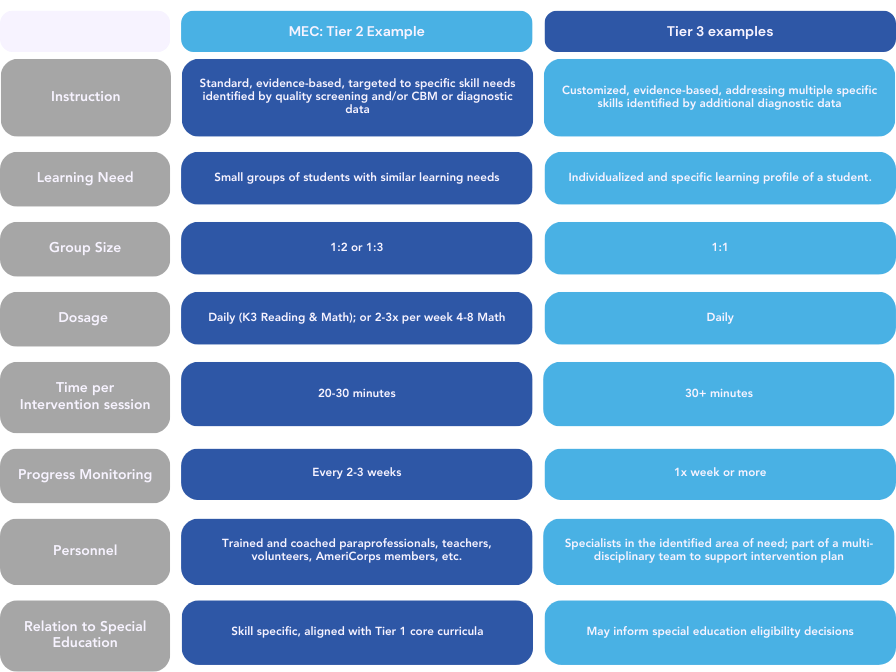
Key differences between Tier 2 and Tier 3 interventions, illustrating how instructional intensity, individualization, and resource use increase across tiers.
Why Tier 2 Is the Most Responsible First Investment
Investing in Tier 2 before Tier 3 is not about avoiding intensive support. It is about using limited and precious resources wisely. Just as most headaches do not require brain surgery, most learning challenges can be addressed effectively through timely, targeted intervention.
Strong MTSS frameworks with high-quality Tier 2 services allow schools to serve more students with fewer resources, resolve learning challenges more efficiently, and preserve Tier 3 supports for the students who truly need the most intensive help.
For schools operating under real financial and staffing constraints, Tier 2 represents the most responsible first investment.

Holly Windram, Ph.D., is the Executive Director of Hope Network’s Michigan Education Corps (MEC). With over 20 years of experience in education, she has held various roles, including School Psychologist and Assistant, Special Education Director, and Special Education Director. Holly has authored educational publications and served on committees and boards, contributing to the field of education.
Additional resources:
https://mtss4success.org/sites/default/files/2022-05/10-features-tier2.pdf
https://mtss4success.org/sites/default/files/2023-03/tier3_infographic.pdf
https://meadowscenter.org/wp-content/uploads/2022/07/10Key_ReadingIntervention_WEB.pdf
Sources:
[1] Wanzek, J., Vaughn, S., Scammacca, N. et al. Meta-Analyses of the Effects of Tier 2 Type Reading Interventions in Grades K-3. Educ Psychol Rev 28, 551–576 (2016). https://doi.org/10.1007/s10648-015-9321-7; Cho Blair, K. S., Park, E. Y., & Kim, W. H. (2021). A meta‐analysis of Tier 2 interventions implemented within skill-specificSchool‐Wide Positive Behavioral Interventions and Supports. Psychology in the Schools, 58(1), 141-161.
[2] https://mtss4success.org/essential-components; Jimerson, S. R., Burns, M. K., & VanDerHeyden, A. M. (Eds.). (2015). Handbook of response to intervention: The science and practice of multi-tiered systems of support. Springer.
[3] Shapiro, E. S. (2014). Tiered instruction and intervention in a response-to-intervention-model. Retrieved from: http://www.rtinetwork.org/essential/tieredinstruction/tiered-instruction-and-intervention-rti-model
[4] Daly, E. J. III, Witt, J. C., Martens, B. K., & Dool, E. J. (1997). A model for conducting a functional analysis of academic performance problems. School Psychology Review, 26(4), 554–574.
[5] Lyon, Fletcher, Shaywitz, Shaywitz, Torgesen, Wood, Schulte, and Olson, Rethinking Learning Disabilities, 2001
[6] https://mieducationcorps.org/outcomes/
[7] Burns, M., Duesenberg-Marshall, M., Sussman-Dawson, K., Romero, M., Wilson, D., & Felten, M. (2024). Effects of targeting reading interventions: Testing a skill-by-treatment interaction in an applied setting. Preventing School Failure: Alternative Education for Children and Youth, 68(2), 113-121.