
Implementing MTSS? Do Not Forget Tier 2 Intervention — Part 2 of 2
What is quality tier 2 intervention?
In Part 1 of this series, we made the case for why Tier 2 intervention is so essential within a well-functioning MTSS framework — and why, just like a headache rarely calls for brain surgery, most learning challenges don’t require the most intensive interventions right away. Now it’s time to tackle the next critical question: what exactly is Tier 2 intervention — and what “counts” as one?
This is a question we hear often from district and school leaders. Does a particular program, curriculum, or practice qualify as Tier 2? And where does high-impact tutoring (HIT) fit in? Is it a Tier 1, Tier 2, or Tier 3 practice — or something altogether different?
The answer, as is often the case in education, is: it depends. But don’t worry—we’ll walk you through exactly what to look for.
Tier 2 and High-Impact Tutoring: Related, But Not the Same
There’s good reason for the confusion. Tier 2 interventions and high-impact tutoring share many features, and in some cases they can be one and the same. But they don’t always overlap. The Venn diagram below captures this well: some Tier 2 programs are also high-impact tutoring, some are only one or the other—and MEC Reading and Math Corps sit squarely in the intersection of both.
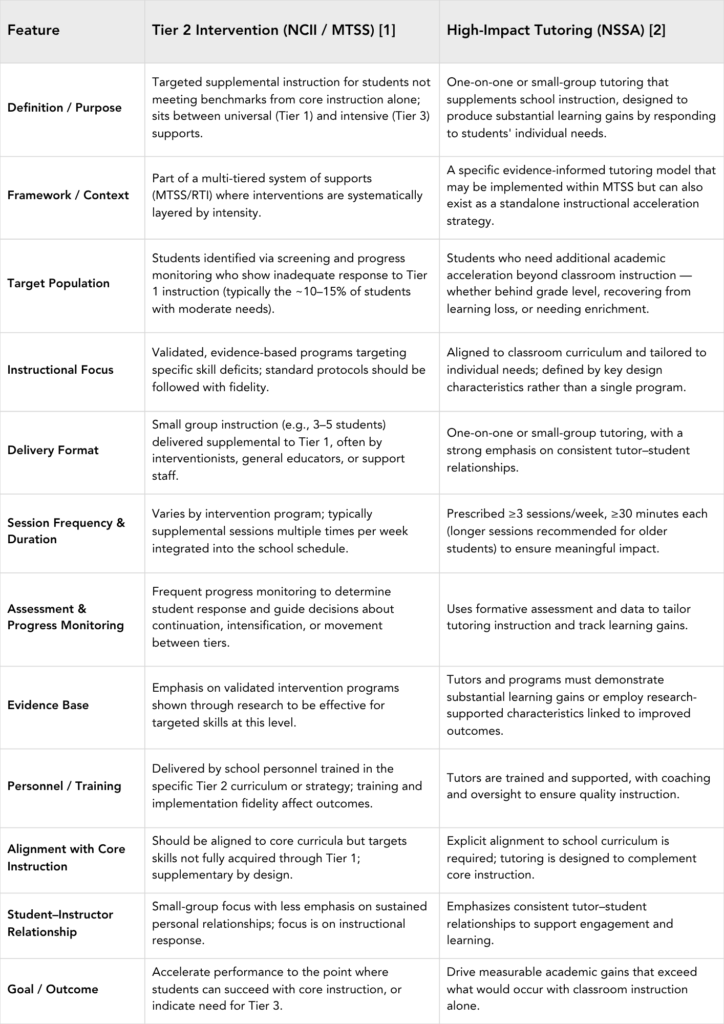
Here’s how two leading national organizations define each:
Tier 2 Intervention National Center on Intensive Intervention (NCII) Part of a structured tiered support system, typically implemented as validated small-group interventions to help students catch up to grade-level expectations.
High-Impact Tutoring National Student Support Accelerator (NSSA) A research-informed tutoring design model with defined principles (dosage, alignment, assessment, relationships, tutor training) that can be used within Tier 2 or other instructional contexts to accelerate learning beyond typical supplemental instruction.
How Do They Compare? A Side-by-Side Look
Quality Over Labels
Why does any of this matter? Because depending on state and local requirements—whether defined in law, regulation, or policy—what “counts” as an evidence-based intervention and/or high-impact tutoring may be defined differently. Our offering to you is a framework for ensuring quality when it comes to determining if the intervention or tutoring will be theright match for an individual’s or small group’s instructional need, regardless of what you call it.
First, within your school or district, having shared language around MTSS, Tier 1, Tier 2, and Tier 3 matters. We encourage conversations that clarify locally how these terms will be used in the context of your community and practice. But the label is ultimately less important than the quality of what’s being implemented.
Instead of getting tangled up in whether a program is called “HIT,” “Tier 2,” or “Tier 3” intervention, focus your energy on whether what you’re doing instructionally actually solves the identified learning need. That’s where being precise really matters.
A Practical Decision-Making Guide
When selecting a solution or program, ask three questions:
- Is the solution aligned to the problem?
- Is the solution feasible to implement?
- Is the solution sufficiently intense enough to fix the problem?
(Evidence-based practice is assumed as a baseline throughout.)
Meet Marshall
Marshall is a 2nd grader whose fall screening score on a reliable, valid, computer-adaptive test placed him at the 30th percentile—below the target and at some risk of not meeting end-of-year grade-level outcomes. His grade-level team identified him as a candidate for Tier 2 intervention.
To determine the right fit, the team administered a curriculum-based measure of oral reading fluency. Results showed Marshall read 2nd-grade passages with strong accuracy but low fluency—he was reading slowly. Given that fluency was the identified skill gap, the team selected MEC Reading Corps, which delivers targeted practice for fluency across a range of reading skills, including connected text. Marshall receives sessions 5 days a week, 20 minutes per session.
Now let’s walk through the decision guide:
Is the solution aligned to the identified problem?
Yes. Marshall has a documented discrepancy in oral reading fluency, and MEC Reading Corps is specifically designed to address that. [3]
Is the solution feasible to implement?
Yes. MEC Reading Corps is available and actively supported at the school.
Is the solution sufficiently intense?
Yes. Daily 20-minute sessions provide enough dosage to meaningfully address the identified gap. [4]
Bonus: How will you know if it worked? Weekly progress monitoring with a reliable, valid CBM tool, reviewed by the team monthly using graphed student data.
Bonus bonus: Built-in fidelity monitoring MEC monitors fidelity of both intervention delivery and assessment data administration and scoring—so educators can be confident that response-to-intervention decisions are grounded in quality data across the board. Learn more about why fidelity matters.
Ready to strengthen your Tier 2 system? MEC Reading Corps and Math Corps provide evidence-based, high-impact tutoring that meets students where they are—fully aligned to your MTSS framework. Learn more about MEC Reading Corps | mieducationcorps.org
Holly Windram, Ph.D., is the Executive Director of Hope Network’s Michigan Education Corps (MEC). With over 20 years of experience in education, she has held various roles including School Psychologist, Assistant Special Education Director, and Special Education Director. Holly has authored educational publications and served on committees and boards, contributing to the field of education.
Additional resources:
https://meadowscenter.org/wp-content/uploads/2022/04/10Key_Tutoring1-1.pdf
https://meadowscenter.org/wp-content/uploads/2022/07/10Key_ReadingIntervention_WEB.pdf
Sources:
[1] National Center on Intensive Intervention (NCII). Intensive Intervention: Using Data to Intensify Academic Interventions for Students with Learning Disabilities. https://intensiveintervention.org
[2] National Student Support Accelerator (NSSA). High-Impact Tutoring: Principles and Evidence. Annenberg Institute at Brown University. https://studentsupportaccelerator.com
[3] Burns, M., Duesenberg-Marshall, M., Sussman-Dawson, K., Romero, M., Wilson, D., & Felten, M. (2024). Effects of targeting reading interventions: Testing a skill-by-treatment interaction in an applied setting. Preventing School Failure: Alternative Education for Children and Youth, 68(2), 113–121.